


Japan is facing a demographic and economic challenge of unprecedented scale: the “2025 Problem.” This crisis stems from the mass retirement of the “Dankai Sedai” (団塊世代) generation: those born between 1947 and 1949, who are now in their late 70s. They were the driving working force behind Japan’s infamous Bubble Economy of the 1980’s.
As these individuals step down from leadership roles, a staggering number of small and medium-sized enterprises (SMEs) risk closure due to a lack of successors. The implications are profound, not just for Japan, but for the global economy.
Why It Matters
The Japanese Economy
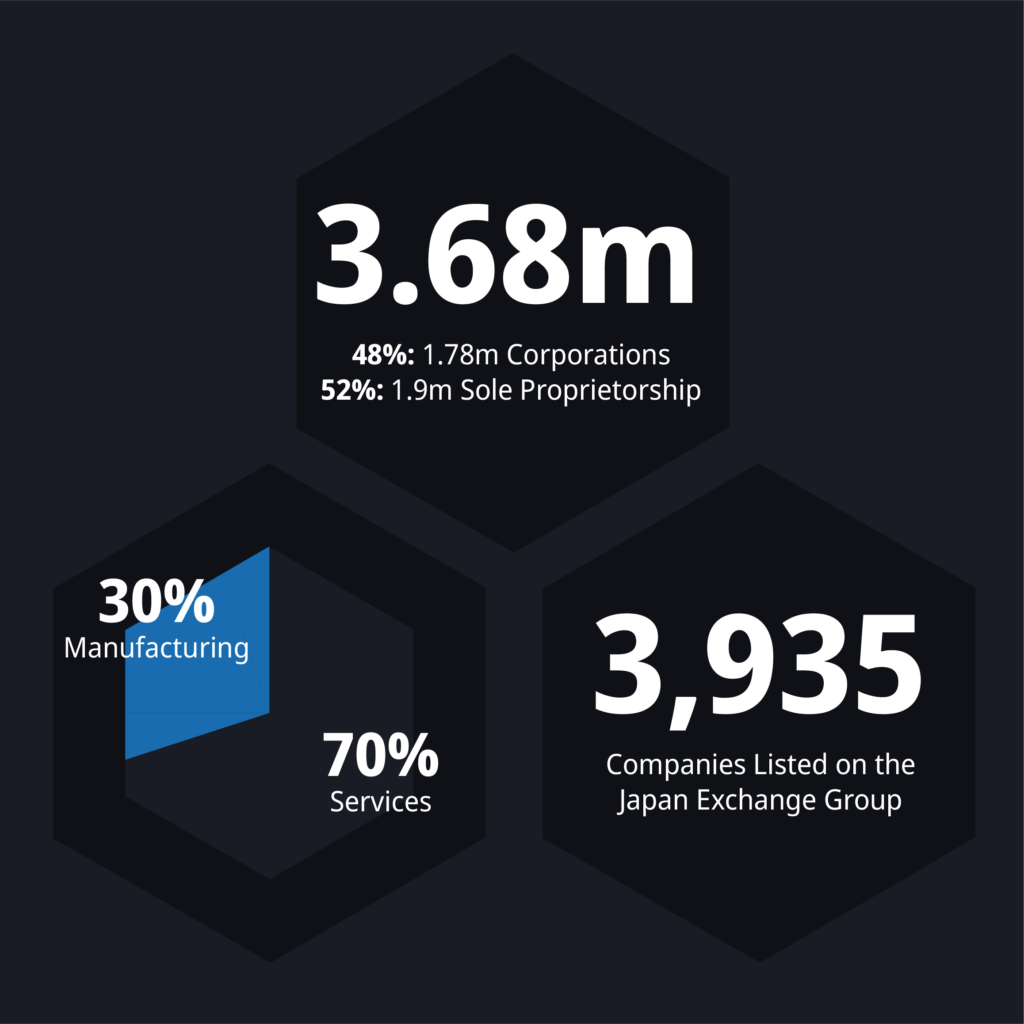
SMEs as the Backbone: Japan’s 3.68 million SMEs make up 99.7% of all businesses. These companies are the lifeblood of the economy, yet 51.8% of business owners are now over 70 years old, and 24.97% are over 75.
Of those 3.68 million SMEs about half are Corporations and about have are Sole proprietorship. Around 30% of those SMEs are in the manufacturing area and employing 70% of the Japanese workforce (as of June 2023)
3,935 Companies are Listed on the Japan Exchange Group.
- Prime Market (including Nikkei 225): 1,640
- Standard Market: 1,600
- Growth Market: 600
The Looming 2025 Problem
Succession Crisis
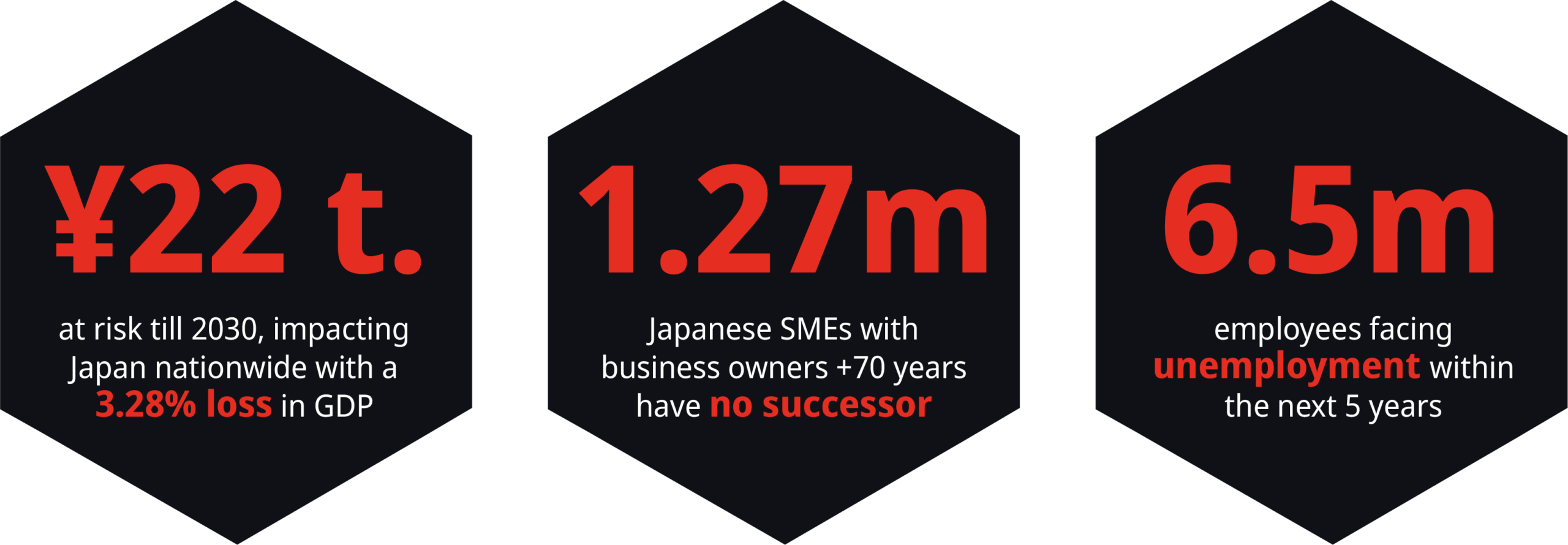
By 2025, approximately 1.27 million SME owners aged 70 or older have no successor, that’s about one-third of all Japanese companies.
Economic Impact
If unaddressed, this crisis could put 6.5 million jobs or almost 10% of total active workforce and ¥22 trillion (±€120 billion) in GDP at risk by 2030, equivalent to a 3.28% loss in national GDP.
The Trigger: Ageing Owners
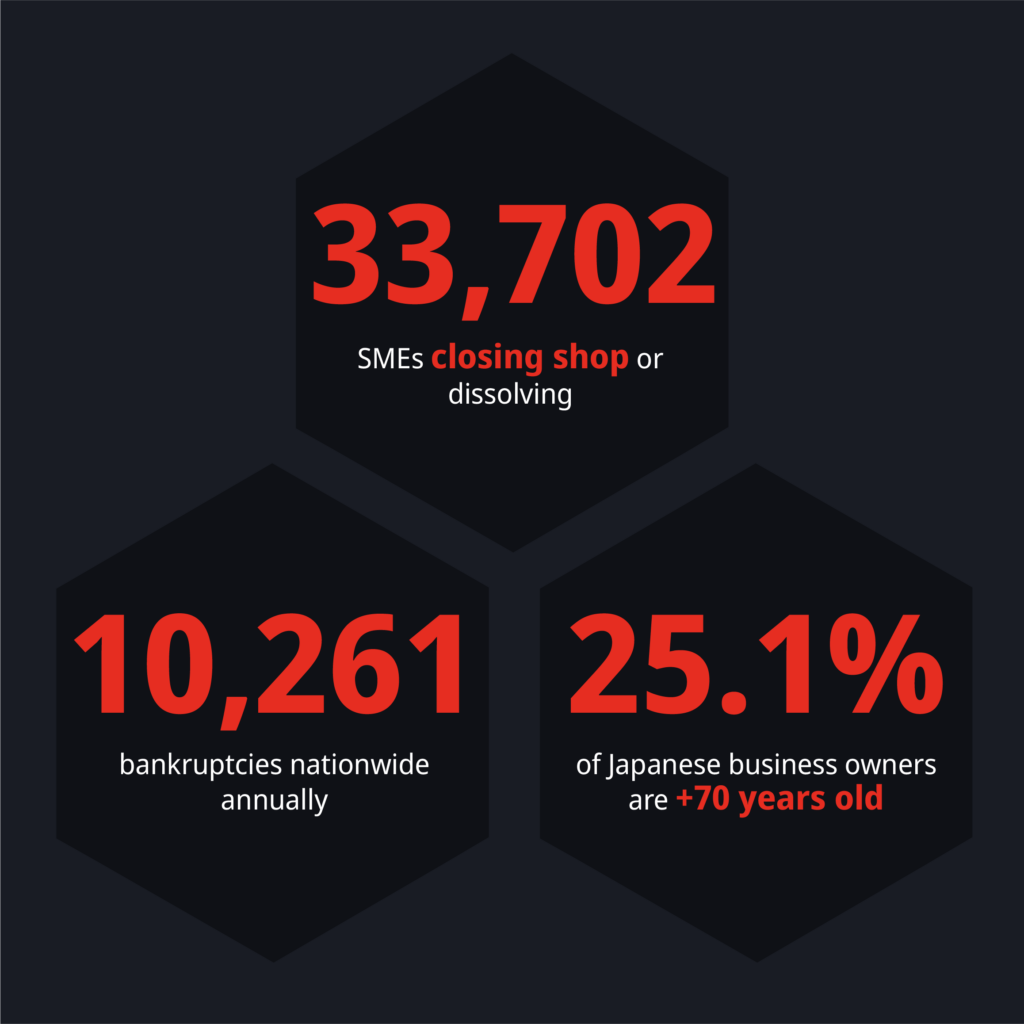
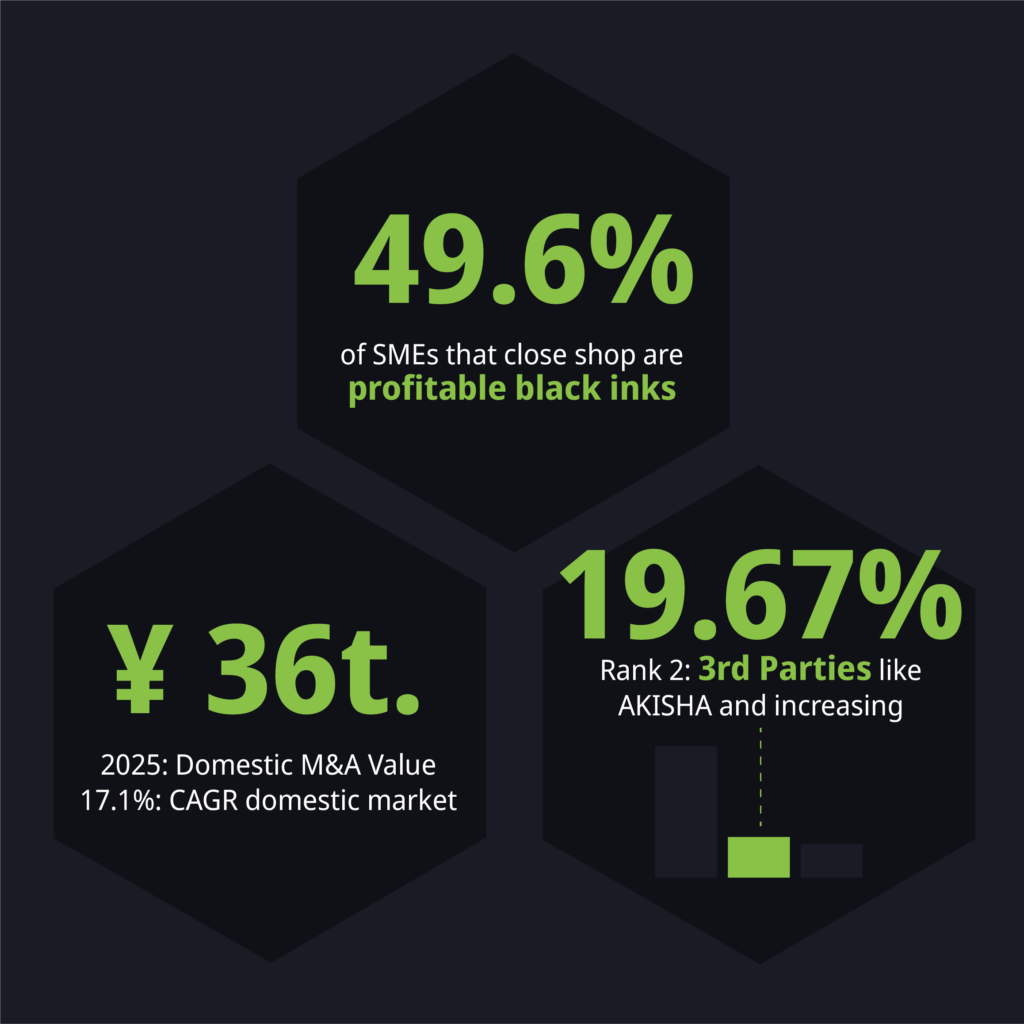
In Japan, the aging of company owners is a significant issue with wide-reaching implications. Out of a total of 67,949 businesses, 49.6% (33,702) are profitable, known as “black inks.”
However, 28.4% (9,571) of these businesses close down due to the lack of a successor. Currently, 25.1% of business owners are over 70 years old and retired, with the average retirement age being 68.5 years. In the manufacturing sector, the average age of current owners is 61.6 years.
This demographic trend is resulting in 10,261 bankruptcies annually nationwide, highlighting the urgent need for solutions to support business succession and continuity.
Japan’s Monozukuri: A Hidden Gem
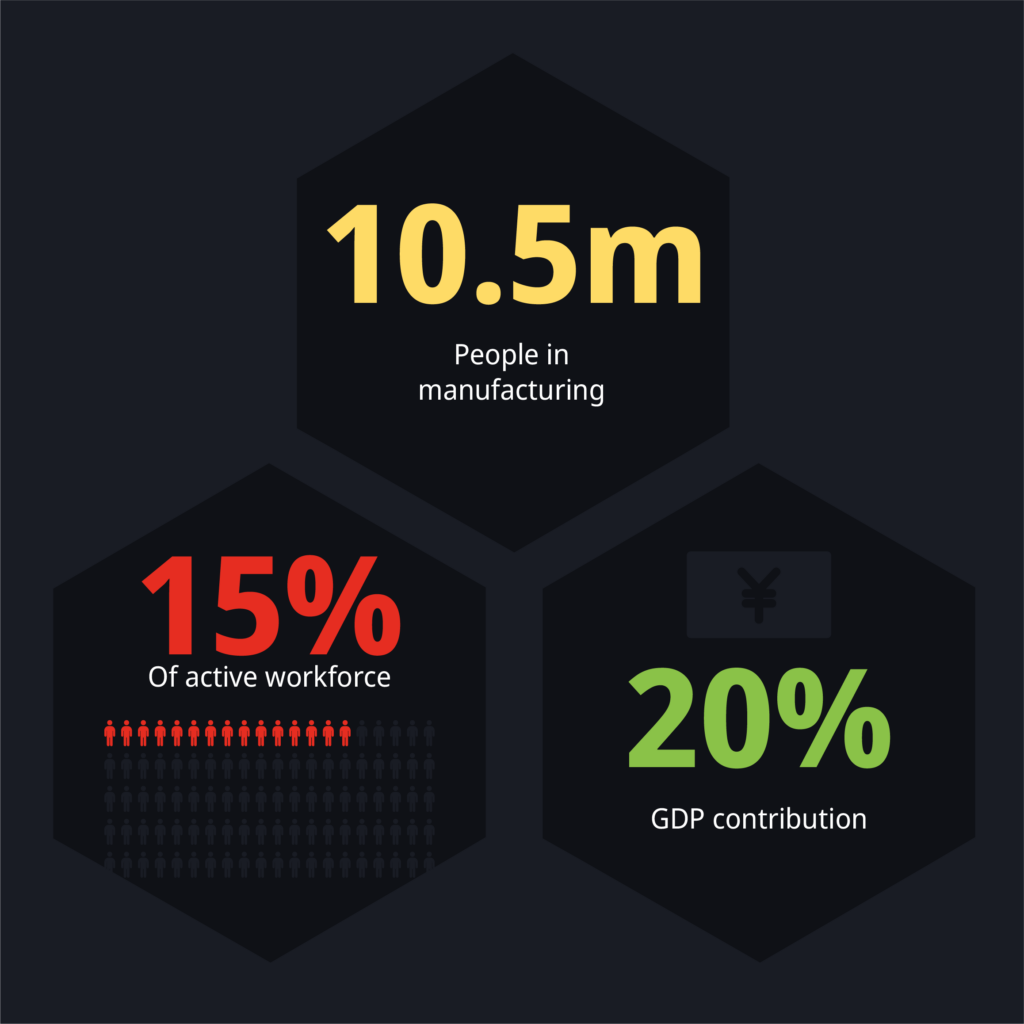
A Sector in Peril: Manufacturing Dominance: 30% of total Japan’s SMEs are in manufacturing, ranking 4th after ICT, Construction, and Transportation.
Manufacturing SMEs employ 15% or about 10.5 million people of the total active workforce, contributing 20% of Japan’s GDP.
Investors: Take Note
Profitable Closures
Nearly half (49.6%) of SMEs that close each year are profitable, shutting down not due to financial failure but because no one is available to take over.
Global Opportunities
The weak yen, reshoring trends from Asia, and Japan’s commitment to quality make its manufacturing sector an attractive target for foreign investment.
Rising M&A Market, A Lifeline for SMEs
Succession-related transactions now account for over 65% of buyout deals in Japan, with the domestic M&A market valued at ¥36 trillion in 2025 and growing at a 17.1% CAGR.
Fresh foreign capital, via private equity, corporate buyouts, or succession acquisitions, could provide these firms with breathing room and extend their lifespans.
Saving Businesses from Closure
- 1st place Family take-over (63,65%)
- 2nd M&A acquisition parties like AKISHA (19,67%)
- 3rd Employee buyout (16,23%).
Key Considerations for Aging Owners Selling Their Company:
- Employment Assurance: 82.1% of M&A deals ensure employment continuity, making them a win-win for both buyers and employees.
- Legacy Preservation: 37.1% of deals focus on preserving the legacy of these businesses, ensuring that centuries-old expertise is not lost.
The Path Forward: Turning Crisis into Opportunity
Preserving Legacy and Innovation
Cultural Heritage: Initiatives aim to safeguard centuries-old expertise, ensuring that traditional industries continue to thrive even as ownership changes hands.
Global Expansion: By modernizing operations and leveraging the “Made in Japan” brand, acquired SMEs can access new markets.
Challenges and Opportunities
Trust and Tradition: Many SME owners are reluctant to hand over their life’s work to outsiders. Building trust and demonstrating a commitment to legacy preservation are critical.
Technological Adoption: Embracing AI, automation, robotics and digital tools can improve productivity and attract younger and female talent, making these businesses more sustainable.
The loss of Japan’s SMEs would mean the disappearance of unique craftsmanship, regional economies, and a significant portion of the world’s industrial capacity.
For global investors, the message is clear
Japan’s SME succession crisis presents a rare chance to acquire high-quality, profitable businesses at a time when the yen is weak and the government is actively supporting foreign investment. The time to act is now!
Sources:
Teikoku Databank, Tokyo Shoko Research, METI, World Economic Forum, OECD, Nikkei Asia, Bloomberg, CNBC, Nippon.com, Markets Group, Eurasia Group, One Step Beyond